|
1. School-based English Language Activities Our school organized a wide variety of learning activities, such as English Wednesday, Primary 1 100 Days of School and recess activities, to arouse pupils' interests in learning English. They could have more opportunities to read, write, speak and listen in a fun and interactive way. Every Wednesday, pupils are encouraged to speak in English with the principal, teachers and fellow schoolmates. English songs are broadcasted to give pupils a fresh start of the day. They are also invited to do a short sharing of famous quotes in the morning assembly so as to bring positive vibes to each and every pupil. Besides, inspirational quotes are taught by teachers every month. It is hoped that positive values and attitudes could be instilled in pupils' minds. 2. P.1-6 Self-Learning Programme Two Self-Study Record Books (SSRB) are tailor-made for all levels in each school year. Pupils revise the target vocabulary from textbook chapters, learn new vocabulary items provided by teachers and record new words learnt on a Self-Study Record Book. A collection of useful websites and online resources are also provided for students for self-study purpose in each chapter. Besides, in order to further promote self-learning among students, dictionary skills are integrated into the SSRB. Students have to tell the part of speech and meaning of the words from the passages in the textbook. This can increase students’ awareness on part of speech of words which enable students to predict the meaning of difficult words in reading.
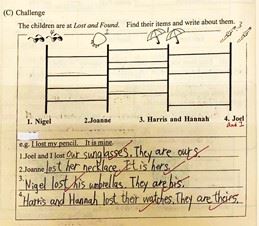
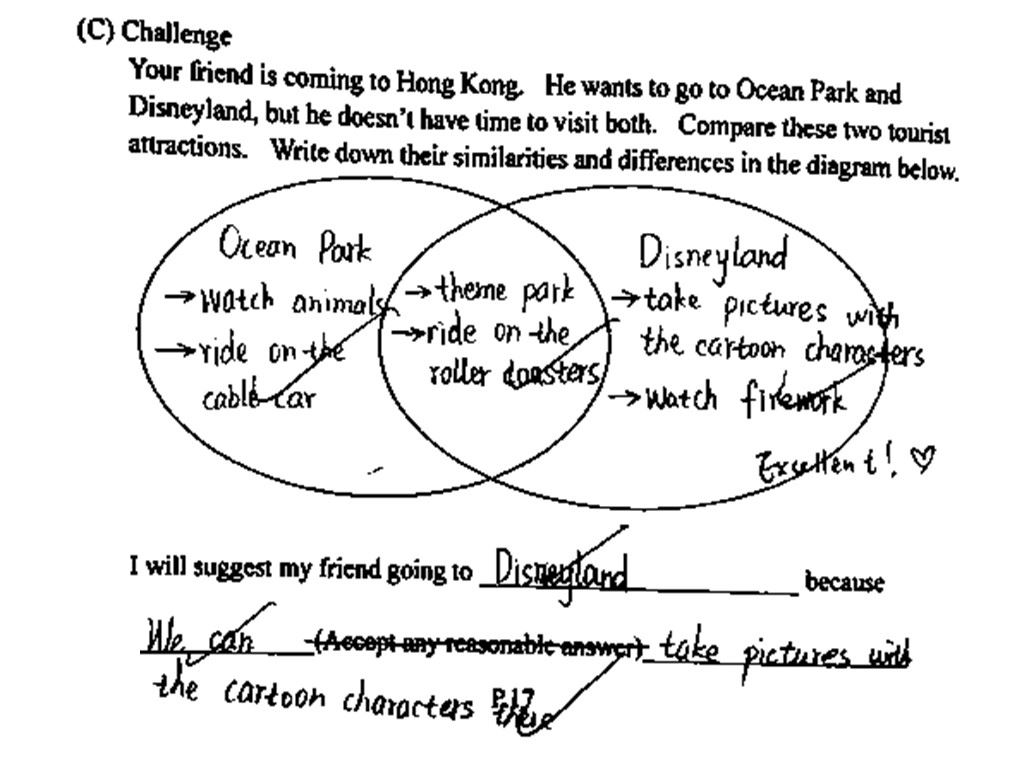
Furthermore, ‘Challenge’ is included for each chapter. ‘Challenge’ is designed to develop students’ higher order thinking skills. Pupils are required to integrate the vocabulary items and the language focus learnt from each chapter in solving various tasks. Those tasks can also help develop students' problem-solving skills and creativity. Grammar notes are provided for pupils so as to assist them in understanding the language focus.
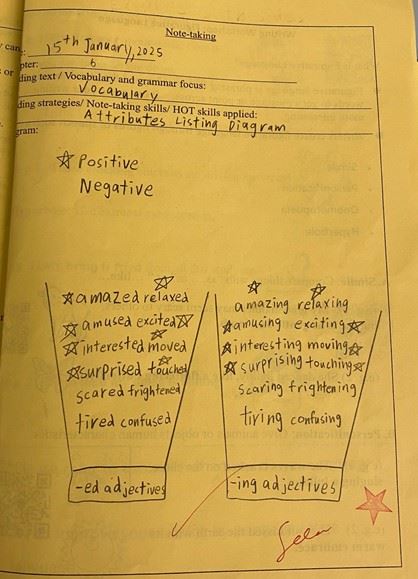
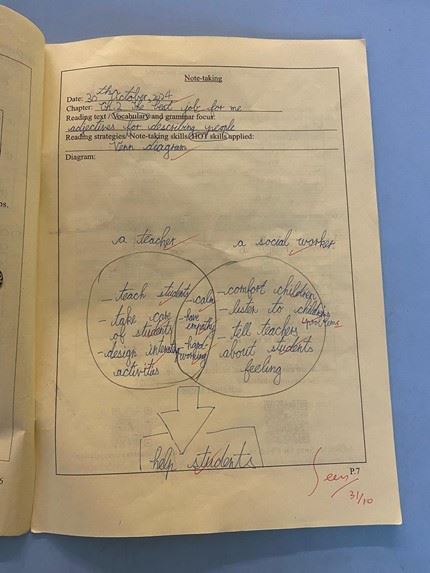
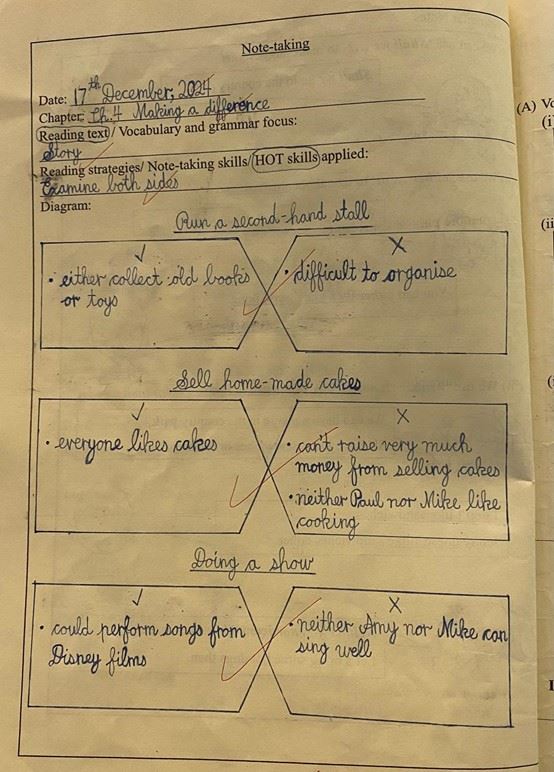
Reading strategies and note-taking skills are the main foci in the English language curriculum. They will be the new elements in SSRB. Note-taking strategies help students to organize and analyze ideas, improve memory retention and promote active learning.
3. P.1-6 Journal It is a free writing task. Pupils write on given topics with guiding questions to develop their writing skills. They are also encouraged to draw pictures to illustrate their ideas. 4. School-based Process Writing Programme Process writing is used which focuses on the development of pupils' writing skills through the various steps involved in drafting, revising and editing a piece of work. Self-assessment will be done after the first draft so as to raise pupils' awareness on content, language and organization of their writing. Teachers also provide constructive feedback on how pupils make improvements on or enhance their writing.
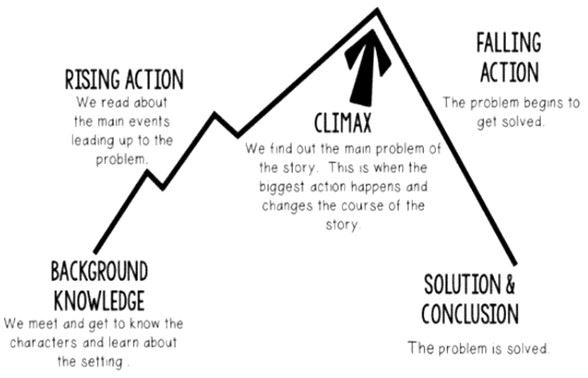
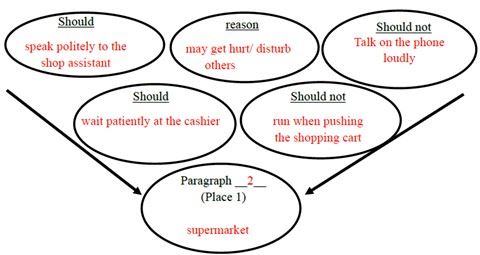
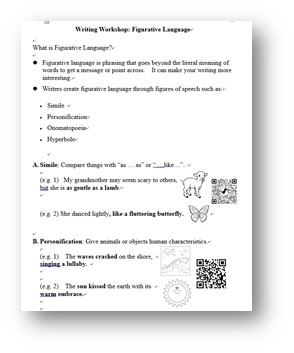
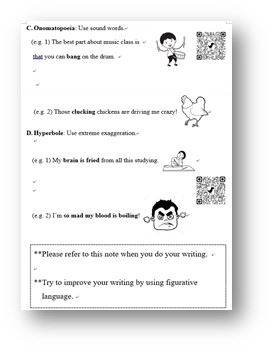
In the writing lessons, different graphic organizers are used to help students to brainstorm ideas and arrange the ideas in order. Furthermore, figurative language items such as similes and personification are included in teaching. Students are encouraged to use any figurative language items to enrich the content and language of their writing.
5. Sharing Garden To enhance students' speaking proficiency, Sharing Garden has been introduced this year. Primary 1 to Primary 6 students are required to give a one-minute presentation based on the topics provided in both terms. They employ 6W higher order thinking skills to prepare their presentation. Through the sharing, students get to reinforce the previously acquired knowledge. Their presentation skills and confidence, which are vital to their speaking, are also being developed continuously. Nonetheless, Sharing Garden promotes peer learning as students have to give feedback on their classmates' presentation. 6. P.4-6 Enhancement Progrmme A native-speaking teacher is hired to further develop pupils’ oracy skills through games and authentic language-rich environment established. Pupils are encouraged to communicate and express themselves in English fluently and accurately. Besides, Reading across the Curriculum will be implemented so as to expose students to authentic texts and connect knowledge learnt in other subjects with English Language learning. 7. P.5-6 English Ambassador Scheme English ambassadors are selected from P.5 and P.6 to tell English short stories to P.1-2 pupils in a small group during recess time. Students communicate and discuss the books and related topics together. A harmonious reading environment is created. Pupils are thus encouraged to develop their reading habit. English oral interaction is also facilitated. English ambassadors are also the editors of the school newsletters. Their work will be published by the end of each school year. 8. Bridging Courses for P.1, P.3 and P.6 pupils To ensure a smooth transition from Kindergarten(K3) to P.1, an English lesson was conducted by the English teachers in late August. Students sang songs and read a story with their teachers. A worksheet was given to students to help them know about the school’s name and their class. In addition, a bridging course was provided for them in the first teaching week of September. They learned some basic greetings, classroom language, classroom rules and revised the alphabets with teachers. They also knew more about people at school in NET lessons.
This year, there are some additional special arrangements for Primary 1.It is aimed to ease P.1 students’ pressure caused by schoolwork. For Dictation arrangement, in 1st Term, instead of having Dictation in the traditional way, Fun Dictation was conducted. Students revise the spelling of words through interactive and fun activities. Starting from 2nd Term, formal dictation will be introduced. Dictation syllabus will be given to P.1 students two weeks prior to the dictation in order to let them get used to the format of dictation and enjoy more revision time. Besides, 1st Term test was substituted by three formative assessments to ensure students not to be overburdened while providing them with the vibe of an assessment.
To ensure Primary 3 students get used to the upper primary curriculum more easily, cursive writing and verb table dictation (past tense) have been gradually introduced to them. Students are observed that they can easily get adapted to the content more quickly and comfortably.
Pre-S1 teaching are integrated in the P.4-6 curriculum. Teaching of the four language skills is covered with the aid of PowerPoint and supplementary exercises/ mock papers. This is done to help P.4-6 students familiarize themselves with HKAT question types and the assessment mode.
|